Annual Meeting Honors Rothstein, Activists for Public Schools

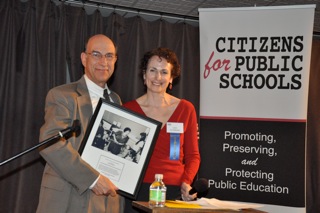
Richard Rothstein accepts Activist for Public Schools Award from CPS's Lisa Guisbond. (Photo by Larry Aaronson)

No sooner did Richard Rothstein graciously accept his Activist for Public Schools Award from CPS than he challenged CPS members and other progressive reformers to rethink issues of educational equity and the “achievement gap.” Demonstrating his adherence to evidence, he passed out a chart showing huge gains in math scores for Massachusetts black 4th and 8th graders between 1992 and 2009. The evidence, he said, does not support the idea that our schools have utterly failed black students. On the contrary, they have made such great gains in math on the National Assessment of Educational Progress, or NAEP, that they essentially closed the gap that existed between them and white and students in 1992. The gap persists because whites have also made gains during that time.

Rothstein’s point was not that school quality doesn’t matter, nor that we cannot improve schools for black students, but that if reform activists buy into the idea that schools alone can make up for larger social inequities and close the “achievement gap,” we are buying what amounts to a losing battle for teachers and schools.   → Read More

Richard Rothstein To Speak at 2011 CPS Annual Meeting

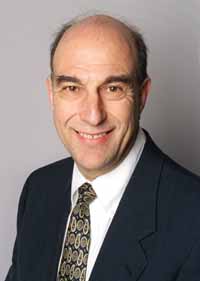
Richard Rothstein

Join us Thursday, April 14, at our CPS Annual Meeting when we honor the extraordinary contributions of researcher and author Richard Rothstein. Don’t miss this rare chance to hear and exchange ideas with the author of Class and Schools: Using Social, Economic and Educational Reform to Close the Black-White Achievement Gap and many other fine books and articles. A research analyst for the Economic Policy Institute and former education columnist for The New York Times, Rothstein’s analysis of education policy and its impact on public school children is unfailingly clear, incisive and based on solid evidence.

Writing in the Washington Post “Answer Sheet” blog, Rothstein said this:  “Making teacher quality the only centerpiece of a reform campaign distracts our attention from other equally and perhaps more important school areas needing improvement, areas such as leadership, curriculum, and practices of collaboration…. Blaming teachers is easy. These other areas are more difficult to improve.   → Read More

Boston Stands Up for Wisconsin Teachers’ Rights

Getting the message out in front of the Fox News office.

Citizens for Public Schools joined the throngs at the Massachusetts State House Tuesday in support of Wisconsin teachers and all workers whose right to bargain collectively is under attack.

Just for the record, though some news reports made it sound like the Tea Party had a significant presence, their numbers were dwarfed by all those who came out to support teachers and other union workers.

For more on this important event, watch for the next issue of the Backpack.

   → Read More

Quote of the Day

“There really is a bipartisan consensus on education reform. It happens to be the Republican agenda of the past 30 years, minus the Republicans’ traditional contempt for federal control of education policy. Where did the Democratic agenda go? So, having no political leadership to support public education, collective bargaining, or the dignity of the teaching profession, we must look for leadership wherever it can be found. Right now, it’s among the people who have stood up for the rights of teachers on the cold and windy streets of Madison, Wisconsin, as well as those who have rallied in their own cities and towns.”

–Diane Ravitch, in the Washington Post’s Answer Sheet blog.

   → Read More

High-Stakes Testing’s Unintended Consequences

Northeastern University Professor Louis Kruger continues to screen his MCAS documentary, “Children Left Behind,” and speak to community groups about the film’s message. A recent article in the Sharon Patch featured an interview with Kruger, a member of the CPS board of directors:

Kruger says high-stakes tests such as the MCAS have “unintended consequences” for the students who fail them.

“The research indicates that high stakes tests do not accomplish their principal aim of improving the academic skills of students, and in addition the tests have serious side effects on our most vulnerable students,” Kruger says.

“If high stakes tests, such as the MCAS, were pharmaceuticals, the FDA would ban their use.”

   → Read More